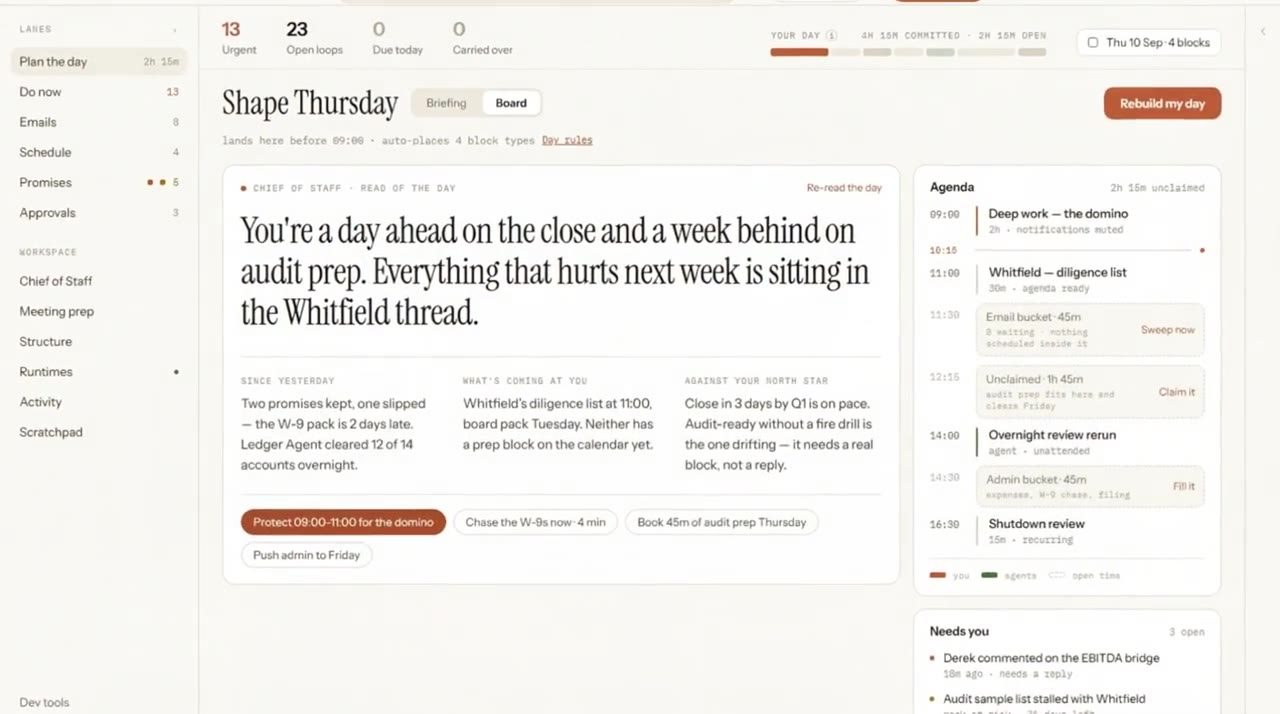
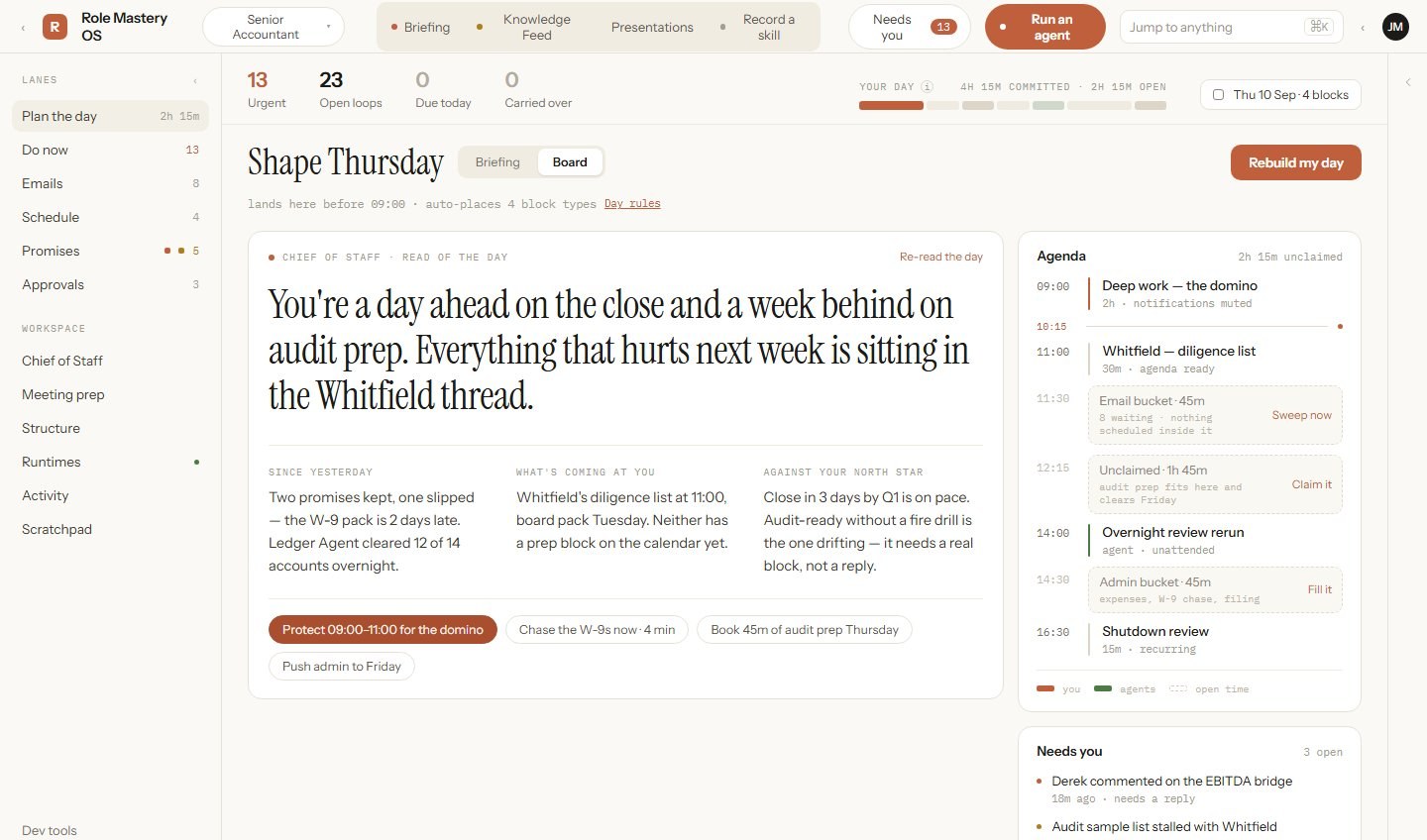
That board is a real install, on a Thursday. Click it and try the lanes and the buttons.
What if the AI you want to use for your work could build the place you do it?
It can. Answer three questions, and the AI you already pay for builds your OS while you watch, for your role, on your computer. There is nothing to learn. Then you use it to do your work.
Three questions to start, about twenty in all as it gets to know you. About ten minutes. Your folder stays on your machine.
Who this is for
People who can see where this is going.
- You know AI should give you back your time and your attention, and cost you less, not more.
- So far it has done the opposite: more time, more cost, more effort, for the same results.
- You know there is a better way, and you would rather try it on your real work than read about it.
Not for everyone, and that is fine.
- If you would rather not use AI at all, this will feel like a lot.
- If learning a new way of working sounds like a chore, it will be one.
- If the bigger picture does not interest you, the small picture here will not either.
How it works
Click. Answer. Installed.
Click
Press the demo button
It is at the top of this page. No account to make first, nothing to read first, and no email until you choose to keep your results.
Answer
Three questions
Your name, your role, and the industry you work in. That is enough for it to start.
Installed
Your OS, for your role
The folder is written where you chose, your engine is checked and signed in, and then it builds the map of your work and the pieces that run it. Then you begin your mastery.
Your name, role and industry go to the AI you already pay for, Claude or ChatGPT, the same way a chat message does. Everything that comes back, the map, the drafts, the finished work, is saved only in your folder on your computer.
You
Three answers
Name, role, industry. Typed once.
Your engine
The AI you already pay for
Claude or ChatGPT. It does the thinking.
Your computer
Your folder
The map, the drafts, the finished work. Yours.
The numbers are from the shipped senior-accountant install. Yours is built from your answers.
Why this, why now
It was never your fault that AI cost you more than it gave back.
Why it has been hard
The chat window forgets
Every session starts from zero. You became the memory, the file clerk, and the manager of a very fast intern. That is more work, not less.
Why now
The models finally know the job
Give one your role and your industry and it can already sketch most of what the role owns, from what it learned. You will see exactly how much when your map generates, before you have paid anything. A folder holds the rest.
Why trust this
The demo is the proof
It generates your map on your own engine before you have paid us anything. If the map comes out, the system can build.
What gets built, in plain words
Six things land in one folder on your computer.
Your engine
The AI you already pay for
An engine is the AI that does the thinking. Claude Max or Pro, or ChatGPT. Your choice.
Your map
Everything your role owns
Your work, in clusters, generated from your three answers. You strike whatever isn't yours.
Folders
One for each part of the job
Leadership, sales, finance, operations, the rest. Each boxed and labelled, so nothing lives in your head alone.
Agents (runtimes)
Small helpers for the repeating tasks
Each one drafts a specific thing you do again and again: a report, an outreach, a reconciliation. Drafts land. You sign.
Loops
The daily, weekly, monthly rhythms
The things that must happen on a schedule, kept moving without you standing over them.
The job description
Chief of Staff
- Owns
- The day's plan, the list of what is next, and the record of what happened.
- Decides
- Which runtime does which task, and what waits its turn.
- Waits for your signature
- Anything with money, a send button, or a promise to someone.
- Reports
- Every morning: what landed, what stalled, what it needs from you.
Not a person, not a separate AI. A page that opens first each day, and the rules it runs by, written down.
Day one
You click. This is what changes.
Your day is already planned
One bar for the working day, each block real. Unclaimed time gets a proposed fill. You move what you like.
The one thing to do now is named
And why now. Who is accountable, which agent is on it, what it is waiting for.
Finished work waits for your signature
Drafts are labelled drafts. Anything with money or a send button stops before it goes out.
 BeforeDay one
Drag the handle. Same desk, same morning.
One week in
Press the button. The work gets done, not just planned.
Imagine it is Friday. Day one was the install. By Friday, drafts land ready to sign, and anything with money or a send button waits for you first.
Before you sit down
The Chief of Staff has read yesterday
What landed, what stalled, what you promised in that meeting. You open to a short list, not a pile, and the first item already says why it is first.
Ten minutes of deciding
Handed the right tool
Each item names its runtime. Run it with one click, or build one on the spot. Like the nurse in the operating room, it hands you the right tool for the task in front of you. You are choosing, not typing.
The machine learns the job
Tell it what went wrong once
A call went sideways on Tuesday. You say so, and it changes the checklist, so Thursday's call starts better without you remembering to be better.
Nothing left in your head
Every part of the role has a home
Goals, projects, deliverables, loops, and the agents that serve them, each in its folder, readable by you and by the next thing you run. If something breaks, you can open the hood: it is plain files.
Built is not the same as good
Every runtime carries a grade, 0 to 3
0: it exists. 1: it has done the job once, on a real example. 2: it does it on your real work, and you signed off. 3: it has been attacked on purpose and held. A straight-A student is not the same as someone who has done the job, and nothing on your board pretends otherwise. When a runtime fails, the fix goes into the runtime, not into your memory, and the same test is run on everything like it. Each failure leaves the system a little stronger than it found it.
By Friday you are not learning a tool. You are running your role, and the role is written down.
What comes back
Time
The ten-minute morning replaces the hour of working out what to do, every day.
Money
Runs on the plan you already pay for. Nothing rented, nothing billed twice, and repeat work can go to the cheapest engine that does it well.
Attention
One list, one next thing named, the rest waits its turn instead of all shouting at once.
Cognitive load
The role is written down. Nothing has to be carried in your head between Friday and Monday.
Yours, on your machine
Not rented space.
It stays
Everything you make stays in your folder
The maps, the drafts, the reports, the knowledge you build up. Usable by the next thing you do, not locked in a chat history that belongs to someone else.
Private models
Your own engine, if you want one
If you want the thinking itself running on hardware you control instead of a rented service, that option exists too. The partner and how it works are in Questions below, for when you are ready.
Its own walls
Built to run inside limits you set
Designed to run in its own space on your computer, with hard limits on what it can reach. Only what you ask the engine goes to the engine; everything that comes back stays here. Nothing irreversible happens without you.
Questions people ask before they install
Is it safe to run on my computer?
It is one folder on your machine. Nothing in it runs until you double-click Setup. Only your prompts go to the AI you already pay for, the same way a chat message does, and what comes back stays in the folder. Finished work waits for your signature, and anything with money or a send button stops before it goes out. It is designed to run inside its own walls, with limits you set.
Why three questions before anything else?
Your name, your role, and your industry are the three things the map cannot be generated without. From those, the AI already knows most of what the role owns, and most later questions arrive already answered.
What does it build, exactly?
A map of your role's work, a folder for each part of the job, small agents for the tasks that repeat, the daily and weekly loops, and a Chief of Staff page that knows what happened and what is next.
Which AI do I need, and what does it cost me?
The demo and your first install run on the plan you already pay for: Claude Max or Pro, or ChatGPT. Nothing bills you twice, and there is no charge from us to see your map. Later, if you want repetitive work done cheaper, you can add a pay-per-use key from another provider with a spending cap you set. Optional, and never needed to start.
Will it make things up?
Sometimes, like any AI. The system is built so that costs little: drafts are labelled drafts. Finished work waits for your signature. Anything with money or a send button stops before it goes out.
How long does it take?
About ten minutes the first time, most of it waiting for an install. After that you open a bookmark.
What does it cost after the demo?
The demo, your map, and the first install are free and run on the plan you already have. You see your first results before anyone asks for anything. When you want to keep them, you create a login, and the pricing for the full system is shown to you then, before you are asked for anything.
What if I want the model itself to be private?
Through our partner charis.im you can run a private model on hardware you control, so the thinking is not rented either. It is something to ask for after your install. Nothing about the demo depends on it.
How do I uninstall it?
Delete the folder. There is no account to close and nothing left behind. Your maps and drafts are ordinary files, so copy them first if you want to keep them.
Click, answer three questions, and your OS is installed for your role.